My Approach To Dyslexia Teaching
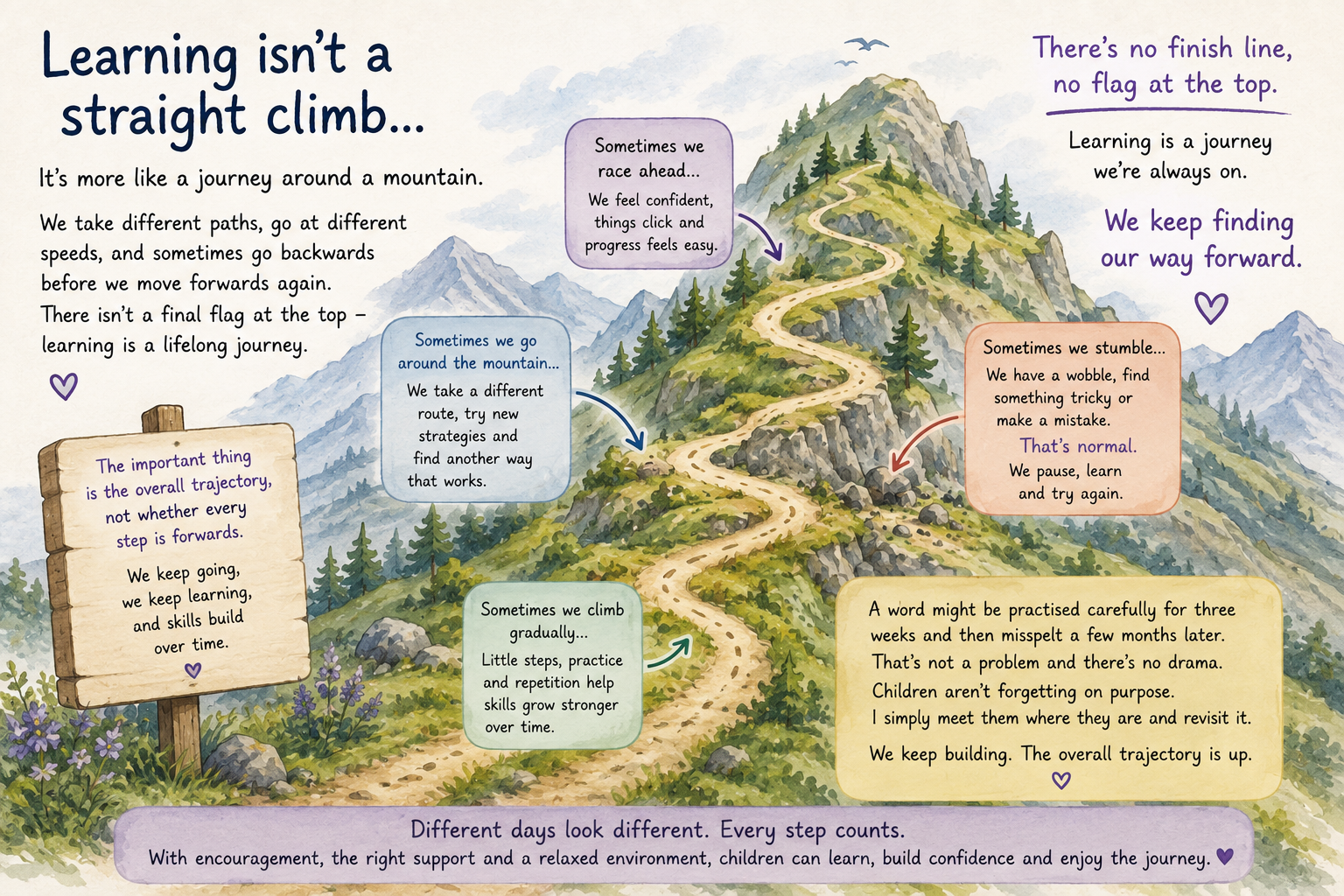
Learning isn’t always a straight climb
Learning doesn’t always mean going straight up a mountain. Sometimes we go around the mountain, sometimes we climb gradually, sometimes we stumble - and sometimes we suddenly race ahead.
A child might practise a word carefully for three weeks, only to misspell it again a few months later. That’s not a problem and there’s no drama. I won’t say, "We learnt that last September!" Children aren’t forgetting things on purpose.
I’ll simply meet them where they are and revisit it. The important thing is the overall trajectory, not whether every step is forwards.
Relaxed children learn better
I try to create a relaxed environment where children feel comfortable, supported and able to have a go.
There is no need to get everything right first time. Mistakes are part of learning, and I try to keep the atmosphere encouraging and low pressure.
I don’t want a child to feel that every lesson is another test of what they can or can’t do. Enjoyment matters too.
Repetition without the pressure
Children with dyslexia often need to meet the same words, patterns and skills many times.
I may find myself saying something similar to a child several times, but in slightly different ways. We might come back to something we’ve already covered, perhaps using a different activity or approach.
That’s perfectly normal. Learning something securely can take time.
Finding a way in
Sometimes a child is simply not keen to write - and pushing harder isn’t necessarily the answer.
I try to find a way in that makes the literacy meaningful. If a new pet is arriving, for example, we might keep a little home diary about it. The child could write a sentence, add an illustration, make a list or record what happened that day.
The important thing is that literacy becomes something they are doing for a reason, rather than simply another task they have been told to complete.
Building skills and confidence
I want children to develop their skills, but also to notice what they can do.
I try to be encouraging and to recognise effort, persistence and progress. Sometimes a small success is worth celebrating — including with a sticker!
For online students, I send a little collection of stickers through the post at the end of term.
Small things make a difference
I also pay attention to the practical side of learning. Good presentation can make work easier to read and can help create a positive first impression.
We might look at simple things such as:
- writing on every other line so work doesn’t look squashed
- using a ruler where appropriate
- leaving spaces between words
- taking a moment to look at the finished work
These aren’t about making handwriting perfect. They’re about helping children produce work that is clear, organised and easy to read.
Parents are part of the team
I encourage parents to be involved, while keeping the child’s learning relaxed.
For online lessons, I may ask parents to send me photographs of work the child has completed during or between the lesson. This helps me see how things are going and decide what might be useful to work on next.
I’ll give feedback and suggestions along the way, so parents have a sense of what we are doing and how they can support their child without turning home into another classroom.
Progress - not pressure
Ultimately I want children to feel that they can learn.
Progress may not always be obvious from one lesson to the next. There may be steps backwards, repeated learning and things that need to be revisited. But over time, skills build.
We don’t have to race up the mountain. We just keep finding our way forward.
Copyright©2026 spotty-dog-tutoring.co.uk
Created and written by Hilary Burt.
All rights reserved. No reproduction without permission.